
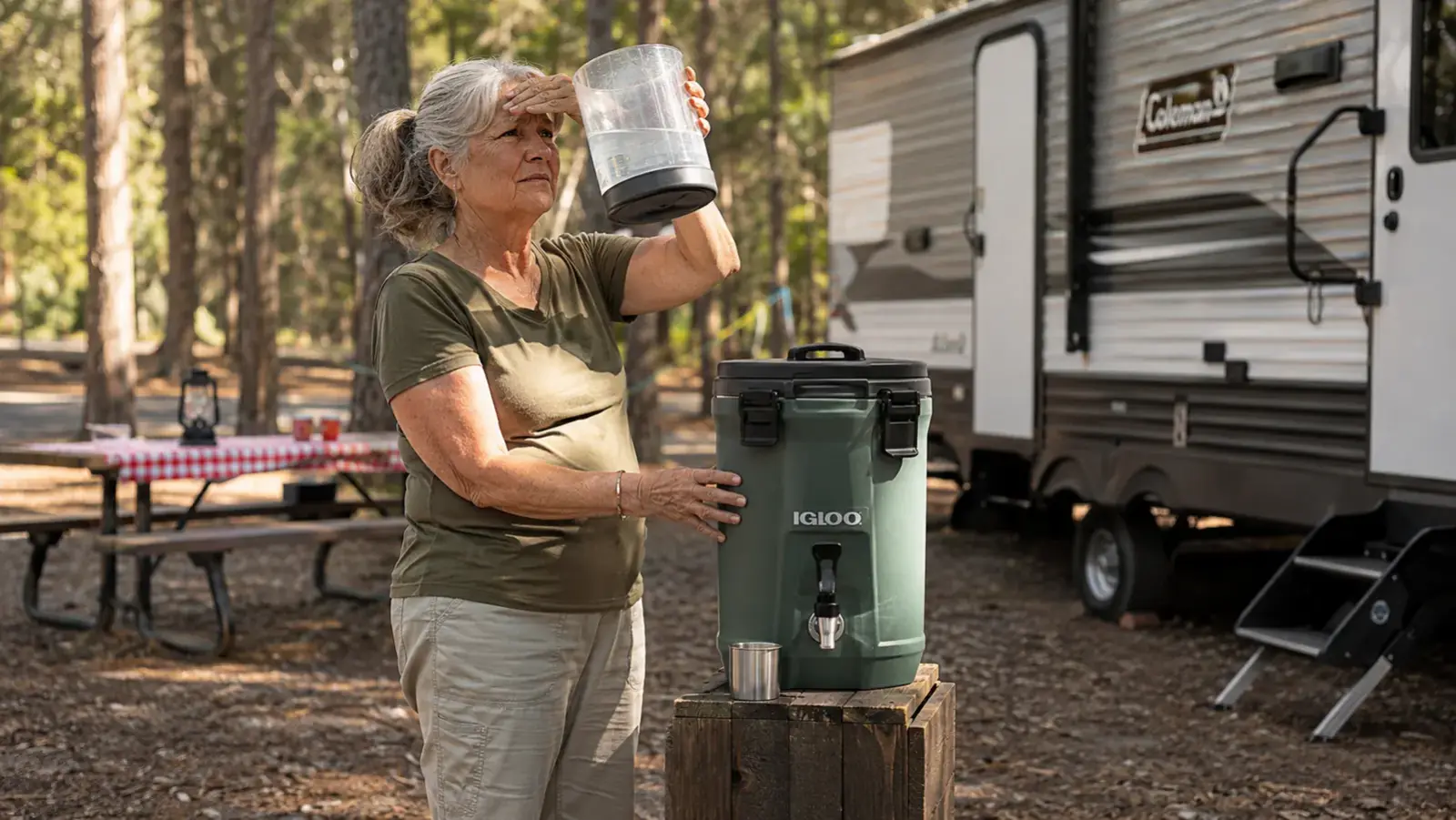
I want to start this one differently than most water jug reviews start, because most of them are written by somebody who filled the thing once, took a nice photo of it sweating on a picnic table, and called it a weekend. I've had the Igloo insulated beverage dispenser in rotation at my campsite for over a year now, the same one Biscuit and I haul from a Corps of Engineers campground on Kentucky Lake to four different state parks and back, and I've got some things to say that the marketing photos don't cover.
None of it is a deal breaker. I still own the thing and I still pack it. But if you're picturing two gallons of water lasting you a leisurely week between fills, or you think you can swing this jug up onto a tailgate one-handed the way you'd carry an empty cooler, I'd rather tell you now than let you find out at your own campsite, alone, mid-fill.
The Quick Verdict
A solid, well-built water jug that does exactly what it says on the box, but the box doesn't say enough about how little two gallons is, how heavy full actually feels, or whether you needed this at all.
Amazon Check Today's Price →Before you buy two gallons of convenience, do the math on how fast your camp actually drinks it.
I did the math the hard way, by running dry mid-afternoon on a trip I thought I'd planned for. Here's the honest version of what this jug can and can't do.
Amazon Check Today's Price on Amazon →How I've Used It
I didn't buy this jug to test it. I bought it to stop hauling water in a leaking plastic milk-style container, and it wasn't until a few months in that I started paying closer attention to the things nobody had warned me about. So I did something a little unfair to the Igloo jug. On a three-day stay at one of my usual state parks, no water hookup at the site, I filled it completely at the start and forced myself not to top it off early the way I normally would, just to see exactly how far a full two gallons carries a retired woman, a dog, a coffee habit, and a set of dinner dishes.
I also weighed it, full and empty, on my bathroom scale set on the trailer step, because I was tired of guessing. And I made myself carry it the way a first-time buyer would, straight off the truck, no staging, no filling in stages, just to feel what that first lift is really like before you've learned any workarounds.
What came out of that weekend is most of what follows. It isn't a bad jug. It's an honestly reported one, which I think matters more. I've since run the same test again with a grandkid visiting for the weekend, just to see how differently the math shakes out when there's a second person splashing through it, brushing teeth and refilling a water bottle every hour, and I'll get to how much faster that emptied the tank in a minute.
The Gallon Math Nobody Does Before They Buy
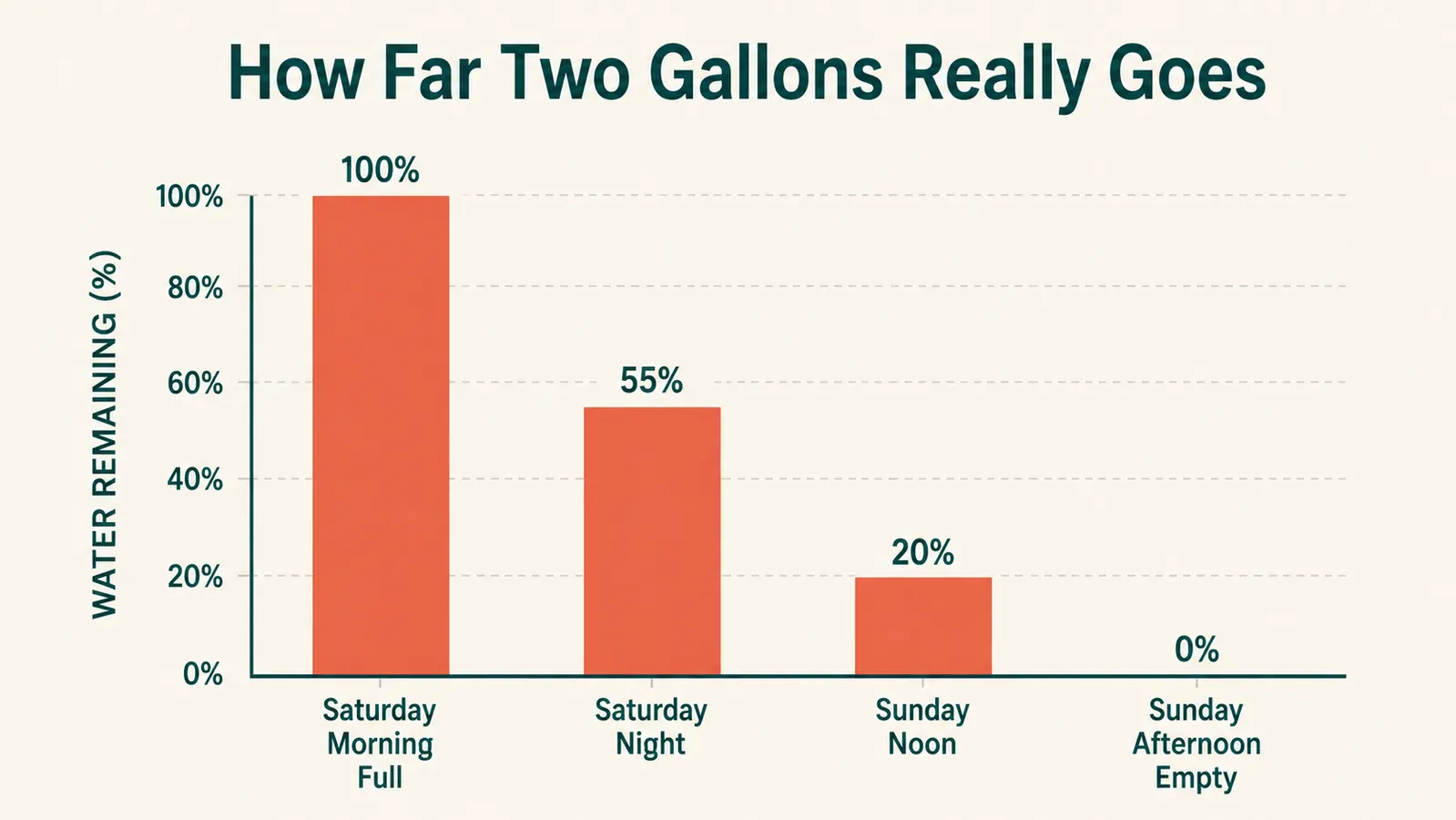
Two gallons sounds like a lot sitting on a store shelf. It is not a lot once it's the only water at your site. On that test weekend, I filled it Saturday morning before breakfast. By Saturday night, after coffee, a pot of noodles, washing that pot, filling Biscuit's bowl twice, and my own drinking water through the day, the level had dropped to a little over half. By Sunday around noon it was down to something I'd call a fifth of a tank, and by mid-afternoon Sunday it was bone dry, days ahead of when I'd mentally budgeted for a refill.
That's roughly a day and a half of real use for one person and a dog, not the week the size of the thing might suggest sitting in your cart online. If you're picturing this as a set-it-and-forget-it water supply for a long stay, recalibrate that expectation now, because running dry on a Sunday afternoon with nowhere close by to refill is not a fun lesson to learn in person.
The weekend with my grandson made the math worse, not better. A second person in camp, even a small one, roughly doubled how often that spigot got pressed, and the same fill that carried Biscuit and me a day and a half was down to fumes by Saturday night alone. If you're camping as a couple or with kids, mentally cut whatever number you were picturing in half again, because one extra set of hands on that lever changes everything about how long a fill lasts.
This isn't really a complaint about the Igloo jug's capacity. Two gallons is two gallons, and a bigger tank would just mean more weight to fight with later, which is its own problem I'll get to. It's a complaint about expectations. Nobody puts "lasts about a day and a half for one adult and a dog" on the packaging, and I think they should.
What Full Actually Weighs, and Why the Empty Weight Lies to You
Empty, this jug feels like nothing. You can pick it up off a store shelf with two fingers and assume that's roughly what you're committing to hauling around a campsite. That assumption is wrong, and it's the kind of wrong that catches you off guard the first time you go to lift it after filling.
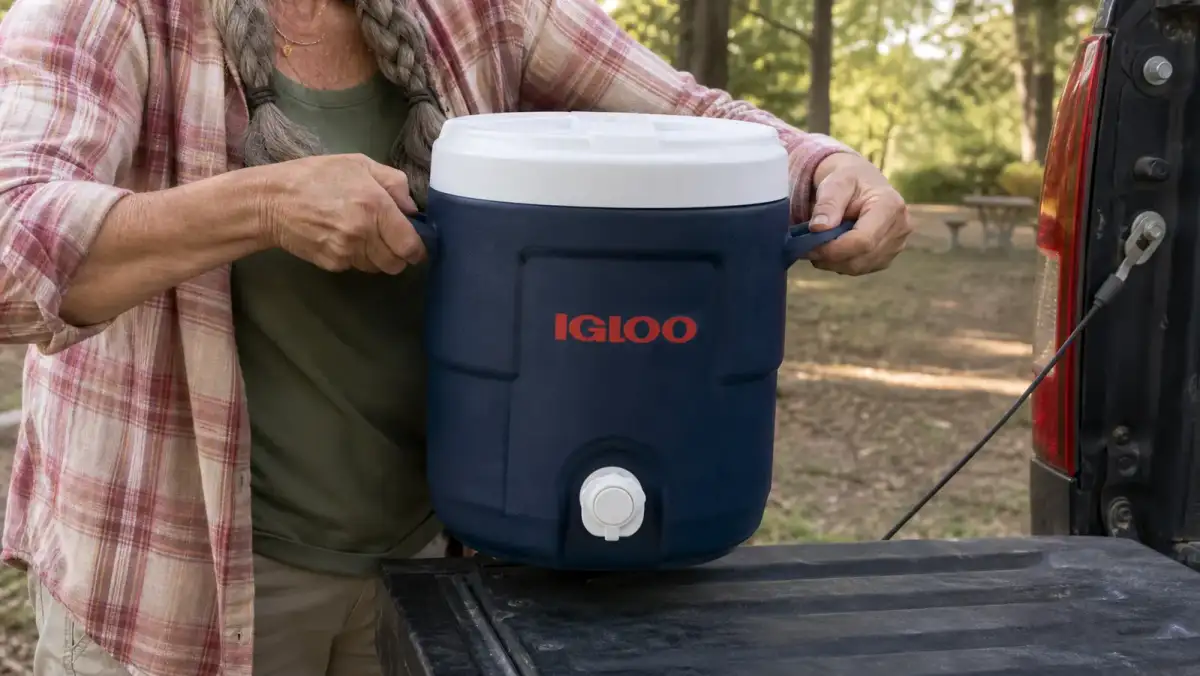
On my bathroom scale, empty it barely registered. Full, with water alone and no ice added, it came in north of twenty pounds. Add a bag of ice on top the way I usually do and you're carrying something that fights back. The molded side handles are fine for steadying it once it's set down somewhere, but there's no good grip for lifting it one-handed the way you'd swing a jug of milk off a counter. Both hands, straight up, no leverage to speak of. I learned that the hard way trying to move it off the truck tailgate solo, and I nearly dropped it the first time.
There's a stability issue that goes along with the weight, too. Once it's full and sitting on anything less than a dead-level surface, a nudge from a passing dog leash or a gust off the lake is enough to rock it, and with that much water sloshing inside, a rock can turn into a tip if the base isn't planted square. I've caught it twice with a quick hand before it went all the way over. On uneven gravel pads, which describes more of my sites than not, I've learned to test the footing before I ever set it down full.
The empty weight is what sells you. The full weight is what you actually live with. If your plan is to fill it at the truck and carry it fully loaded to wherever it lives at your site, plan on doing that in two trips or filling it partway once it's already sitting where you want it, because there's no elegant one-handed way to manage this thing full.
The Real Estate Problem in a Small Trailer
This is the part that surprised me most, because I wasn't thinking about storage when I bought it. This jug doesn't collapse, doesn't nest inside anything else, and doesn't fold flat. It's the same rigid size whether it's full or bone dry, which means it takes up a fixed chunk of space in a 24-foot trailer that doesn't have a fixed chunk of space to spare. It rides in the truck bed on the way in, and then it needs a permanent spot at the site, because there's nowhere in my trailer to tuck it away between fills.
I used to travel with a soft-sided collapsible jug that folded down to almost nothing when it was empty, and I'll admit I miss that about it, even though that jug never kept ice worth mentioning and the spout on it eventually split. This rigid dispenser trades that packability for real insulation and a spigot that holds up, but the tradeoff is real. It rides the same in the truck bed whether it's Monday morning or Friday night, and there's no version of stuffing it into a cabinet with the folding chairs the way I used to with the old one.
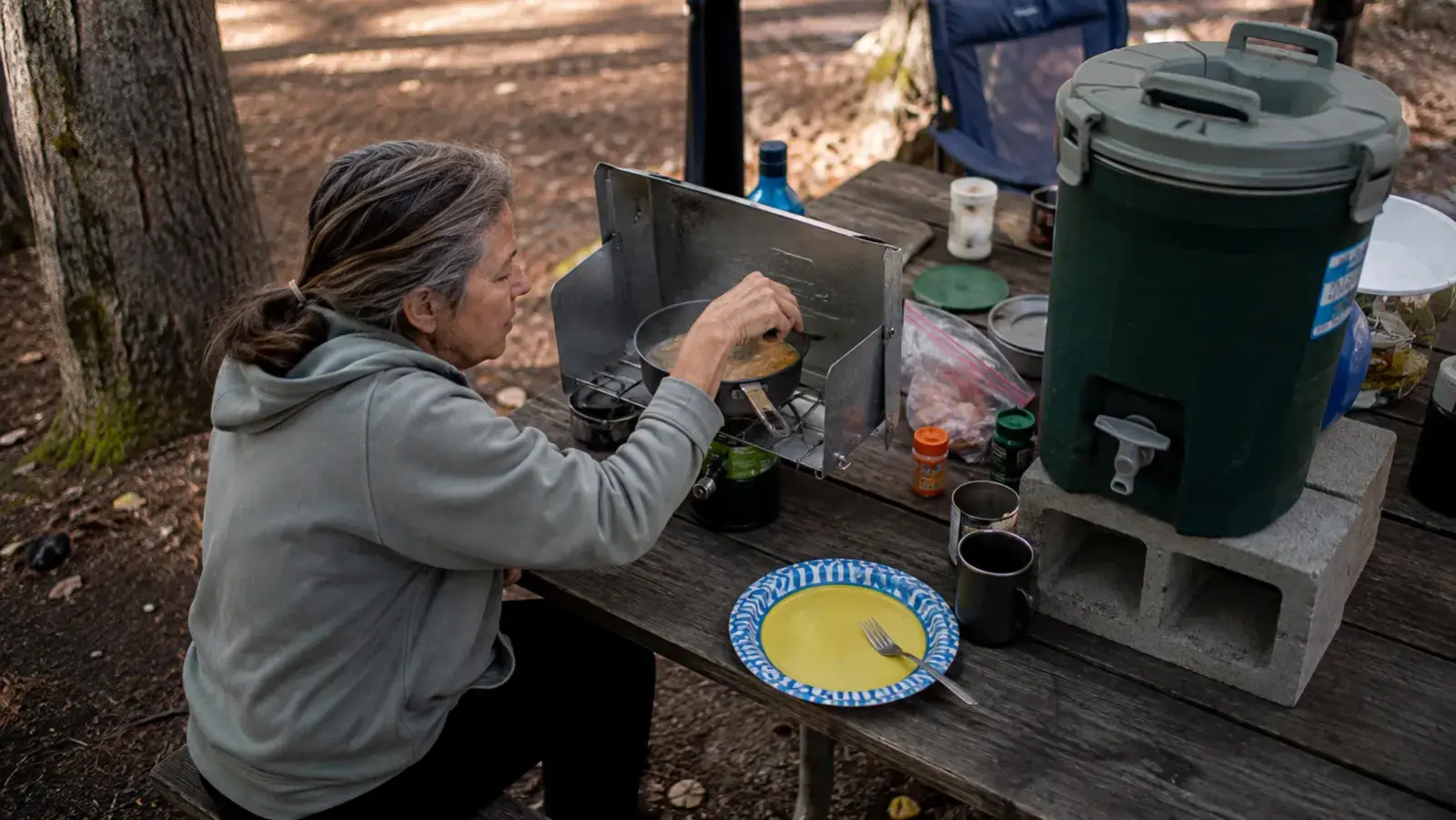
It's also taller than it looks in photos, and the spigot sits low enough that you can't just set it on the ground and expect to fill a cup or a pot underneath without kneeling. I've had to prop it up on an overturned crate, a stack of cinder blocks, or whatever I can find at a given site so the spigot clears the surface below it. At more than one site, the only flat, sturdy thing tall enough to do that job was my picnic table, which meant I lost the whole table to the water jug for the length of my stay. A folding side table solves that if you pack one, but that's one more thing to carry, and it isn't mentioned anywhere in the product listing.
The Plastic Taste, and the One Thing This Jug Will Never Be
The first few fills had a distinct plastic taste to the water, the kind you get from new food-grade plastic before it's had a chance to air out and get rinsed a handful of times. It wasn't awful, but it was noticeable enough that I filled it, dumped it, and refilled it twice before the first trip just to knock some of that new-jug flavor down. By the third or fourth use it had mostly faded, but I wouldn't plan on your first sip out of a brand new one tasting like nothing.
The bigger thing I want to be honest about is what this jug is not. It is a container. It holds and pours whatever water you put into it, nothing more. It doesn't purify, filter, or improve the water in any way, and it will hold exactly whatever quality of water your campground spigot hands you. If the water at your site tastes or looks questionable going in, it will taste and look the same coming back out of the spout, ice cold or not. I fill mine from a tap I already trust, and that's a decision you have to make separately from whether you buy this jug at all. I'd rather say that plainly than let anyone assume otherwise.
The Question I Almost Didn't Ask: Do You Actually Need One?
Here's the part most reviews skip entirely, because it doesn't help sell the thing. If your usual campsites have water running right to the pad, a spigot within a few steps of your rig, this jug might genuinely be more gear than you need. I camp mostly at older park loops and Corps of Engineers sites where water doesn't reach every pad, which is exactly why this earns its keep for me. But I've stayed at plenty of newer state park loops where a hose bib sits three feet from my trailer door, and on those trips this jug mostly just sat there, full, taking up table space I didn't need it to take up.
If that's your normal camping situation, water at every site, short weekend stays, nobody depending on you for their bowl refills, I'd think twice before adding this to the truck. It's not a bad product. It's a specific-problem product, and if you don't have that problem, you're paying for capacity, weight, and table space you'll never actually use.
What I Liked
- Well built and genuinely insulated, no complaints about the core construction after a year of use
- Ideal for sites with no water at the pad, where hauling once really does beat multiple trips
- Spigot design is easy to operate one-handed once the jug is set somewhere stable
Where It Falls Short
- Two gallons is closer to a day and a half of real use for one person and a dog than a week, less with a second person
- Full weight, north of twenty pounds before ice, has no good one-handed carry
- Can rock and tip on uneven ground once full if the base isn't planted square
- Doesn't collapse or nest, so it claims a permanent chunk of space in a small trailer
- New-jug plastic taste for the first few fills
- Holds whatever quality of water goes in, it filters nothing and improves nothing
Nobody puts 'lasts about a day and a half for one adult and a dog' on the packaging. I think they should.
Who This Is For
This jug is for people camping at sites where water genuinely isn't within easy reach, who would rather haul once a day than make three separate trips with a smaller container. It's also a fair fit if you travel with a dog who needs a bowl refilled through the day and you'd like that supply sitting at the campsite rather than back at the trailer's tank. I've written more about that side of it in the story of how this jug kept Biscuit's water topped off through a hot stretch last summer, if that's more your situation than mine.
It's also worth having if you've been disappointed before by cheap plastic jugs that let water go lukewarm by lunchtime. Whatever else I'll say about the weight and the footprint, the insulation itself has never let me down, and if keeping drinking water genuinely cold is your main goal, I laid out more of what actually works for that in my full rundown on keeping water cold at camp.
Who Should Skip It
Skip it if your campsites always have water at the pad and your stays run short. Skip it if you're tight on storage in a small trailer or a car camping setup and can't dedicate a permanent spot to something that won't fold down or nest with your other gear. And skip it if you were hoping for anything close to a week's worth of water out of one fill for more than a single person, because the honest math just doesn't stretch that far. None of that makes it a bad product. It makes it the wrong product for a certain kind of trip, and I'd rather tell you that up front than have you find out after you've already loaded it into the truck.
If your site has no water at the pad, this earns its keep. If it doesn't, save your table space.
This is the same jug I've hauled to Kentucky Lake and back for over a year. Know the gallon math and the weight going in, and it'll do exactly what it promises.
Amazon Check Today's Price on Amazon →