
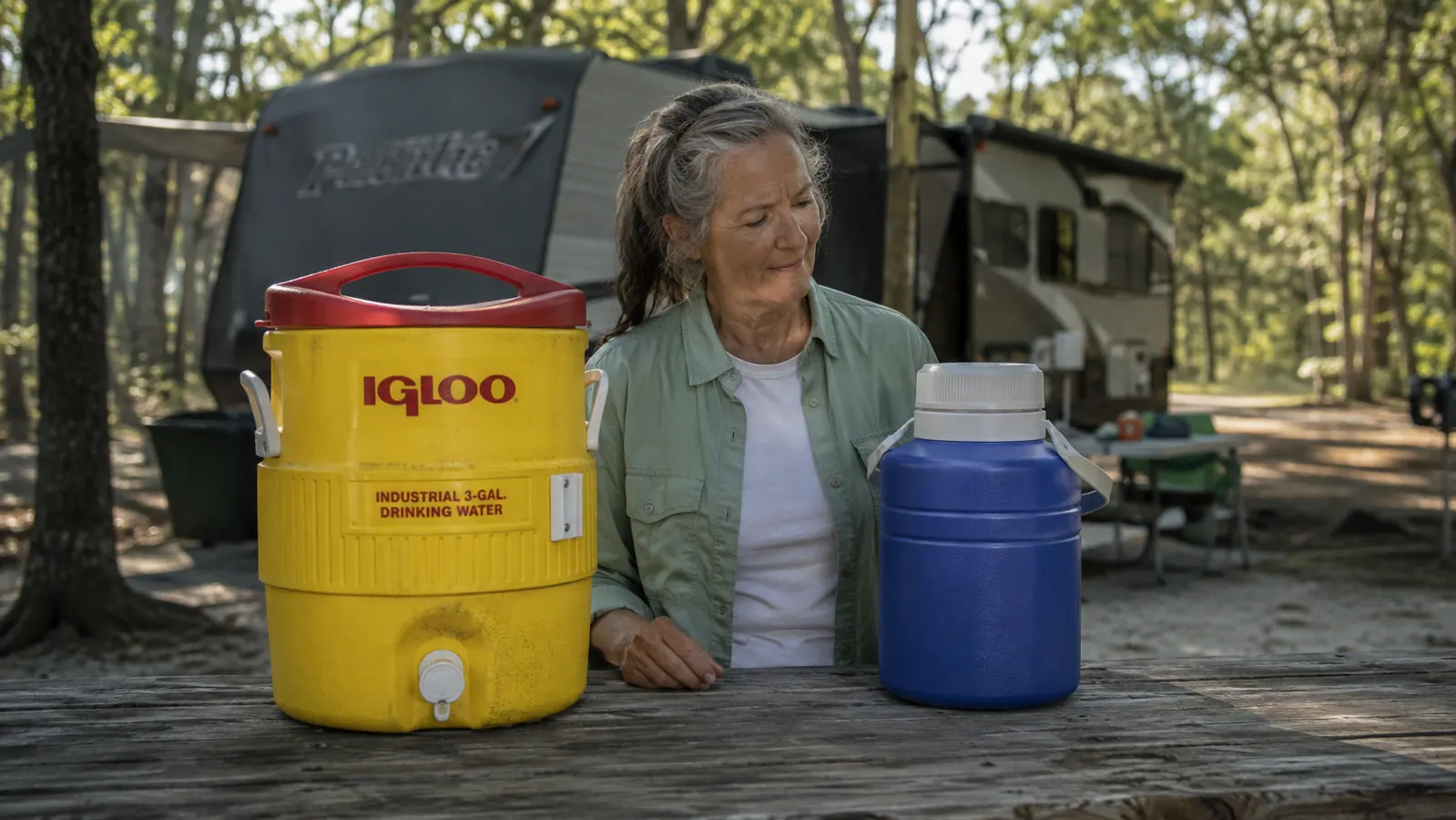
Short answer first, since some of you just want the answer and not my whole story about it. If you're filling a dog bowl three or four times a day and pouring with one hand because a leash is wrapped around the other, get the Igloo insulated beverage dispenser with the spout. If all you need is to haul drinking water from a spigot to a coffee pot once in the morning and once at night, a plain hard-sided jug does that job fine, costs a lot less, and you don't need anything else I'm about to tell you.
I own both, and I've used both hard, not just for a weekend review. The plain jug came first, a blue five-gallon hard-sided jug I bought at a hardware store years before I'd ever seen a dispenser with a spout on it. It still rides in the truck bed as backup. The Igloo dispenser came later, after a stay at a Corps of Engineers campground on Kentucky Lake where the water spigot was a good hundred and fifty yards from my site and I was refilling Biscuit's bowl every time he wandered in from the loop. I ran the two of them side by side for most of a season before I was willing to say one actually earns its keep over the other, rather than just being the newer one.
How I Actually Compared Them
This wasn't a weekend test. I set both containers up at the same sites, filled with the same tap water and the same bag of ice each morning, and left them out in the same spot on the picnic table through the heat of the day. I checked the water by hand every couple of hours, and on the hotter days I kept a little kitchen thermometer in my supply tote just to have a number instead of a guess. I also tracked how many times a day I actually reached for each one, which turned out to matter more than any single afternoon of testing.
I ran this comparison across four different sites over about ten weeks, mostly mid-week stays the way I always camp, at a Corps of Engineers campground on Kentucky Lake and at two of the state parks I return to most. Some of those weeks were mild, low eighties and shaded sites. A couple were brutal, high nineties with no real tree cover until afternoon. I wanted to see both containers under easy conditions and under the kind of heat that actually separates them, because a hardware store jug will keep water cool enough on a sixty-degree morning. The test that matters is the one where the sun is working against you all day.
I also paid attention to the boring stuff nobody photographs for a review. How long it took to fill each one at the spigot. How much counter or table space each one actually needed. What the inside smelled like after two weeks in storage between trips. Those small annoyances add up faster than a single dramatic difference in ice retention, and they're the reason this comparison isn't a clean sweep for either container.
| Igloo Insulated Dispenser | Standard Water Jug | |
|---|---|---|
| Ice retention on a hot afternoon | Foam-insulated double wall kept ice cubes floating past 5 p.m. on a 90-degree June day at Kentucky Lake | Ice was gone by early afternoon in the same heat, water down to lukewarm by dinner |
| One-handed pouring for the dog bowl | Push-button spout fills a bowl one-handed while the leash stays in the other hand | Needs both hands to tip the whole jug, awkward with a dog underfoot |
| Spout reliability over a full season | Push-button spout hasn't dribbled or stuck once after months of daily use | No built-in spout at all, just a screw cap you remove and pour from directly |
| Water capacity per fill | About 2 gallons before I need to walk back to the spigot | 5 gallons, more total water before a refill trip is needed |
| Empty weight and packing | Roughly 4 pounds empty, the folding stand and spout add bulk in the trailer's storage bay | About 2 pounds empty, nests flat and takes almost no room when empty |
| Cleaning between trips | Wide lid comes off for scrubbing, but the spout and gasket need their own attention or they'll hold mustiness | Nothing but a screw cap and a wide opening, rinses clean in under a minute, nothing to trap odor |
| Table and counter stability | Sits level on its folding legs at bowl height, doesn't tip when Biscuit bumps the table leg | Sits directly on the ground or a table with no stand, easy to knock over when full |
| Serving water to people and a pet all day | One push of the spout per pour, no cap to unscrew and reseal each time someone wants a drink | Every pour means unscrewing the cap, tipping, and screwing it back down before the next person or the dog needs water |
| Price | Around fifty dollars, insulated body, spout, and folding stand included | Typically ten to twenty dollars for a basic hard-sided jug with no insulation |
Where the Igloo Dispenser Wins
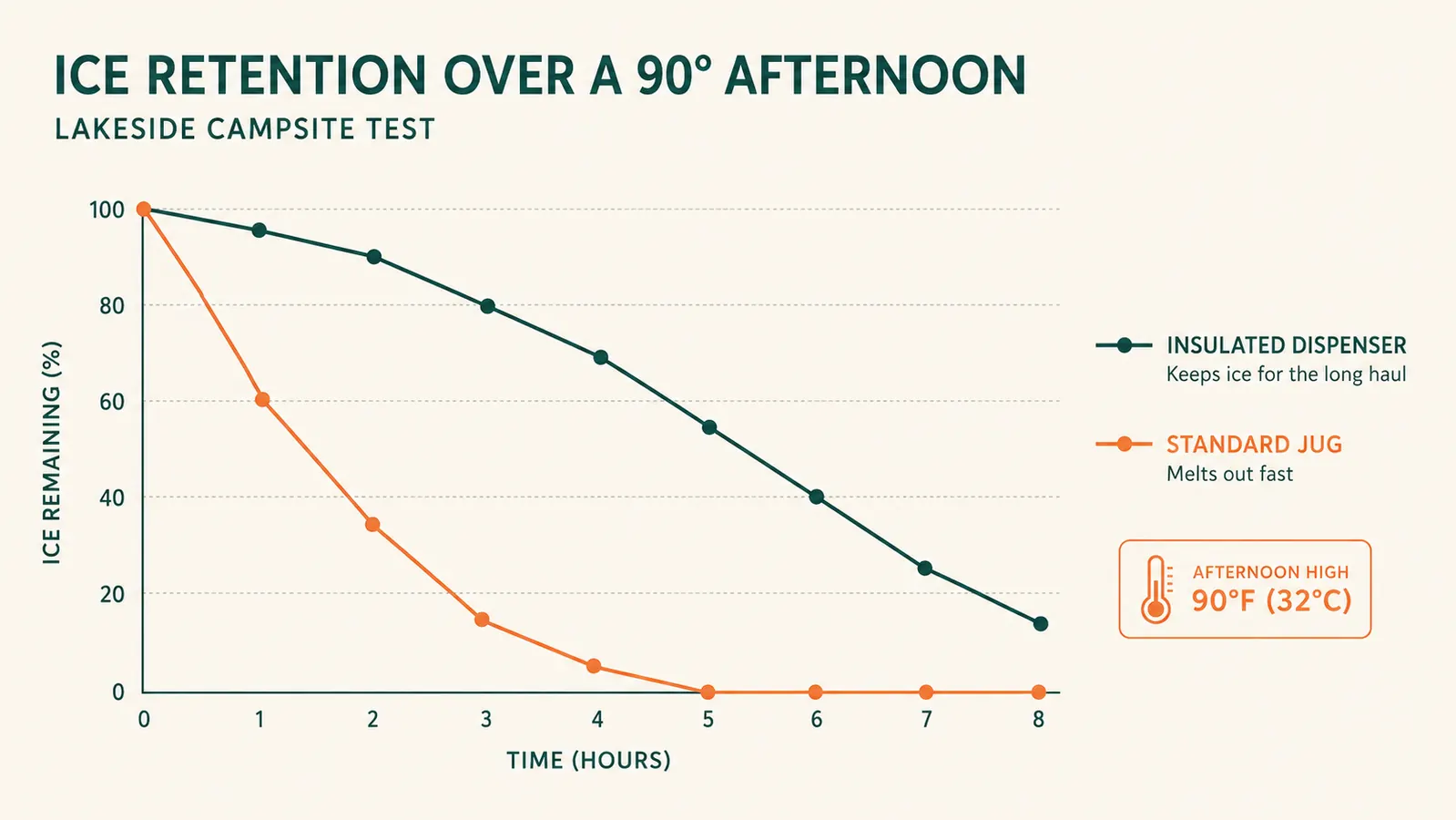
The insulation is the whole story here, and I didn't fully believe it until I tested it against the plain jug on the same afternoon. I filled both with the same ice from the same bag around eleven in the morning at a mid-week site on Kentucky Lake, June, temperature pushing ninety by early afternoon. By two o'clock the plain jug's water had gone from icy to just cool. By five, it was flat lukewarm, the kind of water that doesn't taste like anything anymore. The Igloo dispenser still had ice cubes floating in it at five, and the water coming out of the spout was cold enough that I noticed the difference the second it hit my hand.
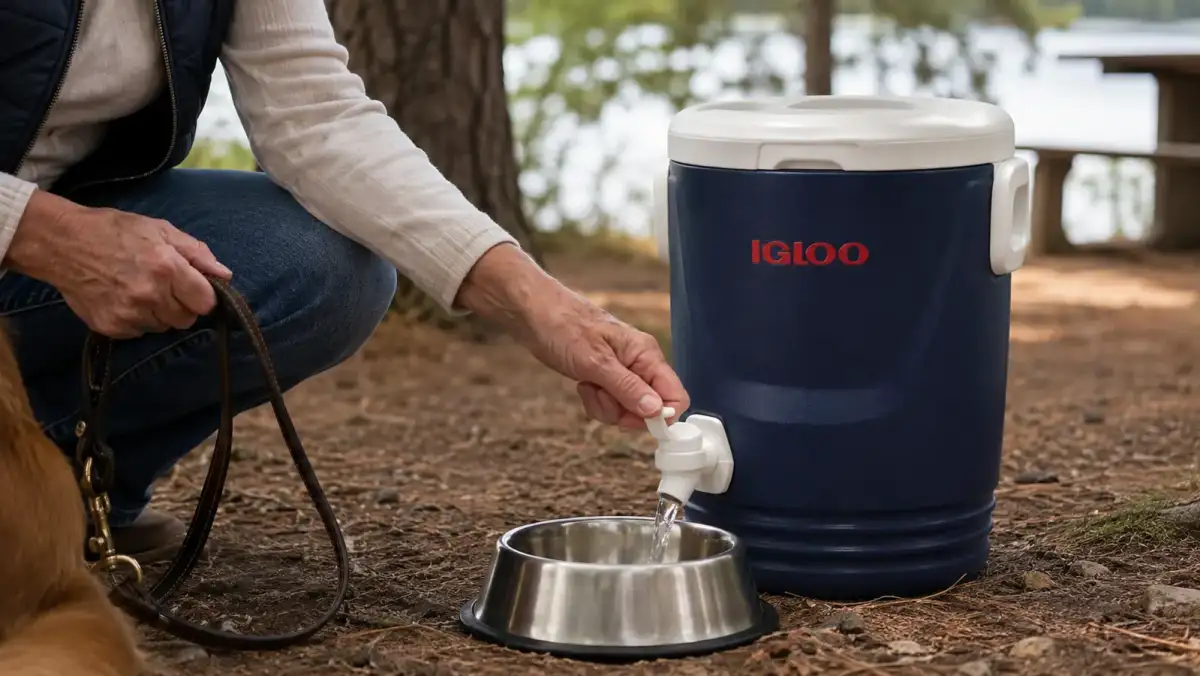
The spout matters more than I expected it to when I first bought this thing. I'm filling Biscuit's bowl on the ground, holding his leash so he doesn't wander off toward the neighbor's site, and I need my other hand free to actually work the container. With the plain jug, that used to mean setting the leash down, using both hands to tip several pounds of water, and hoping Biscuit stayed put for the five seconds that took. With the dispenser, I press the button, the water comes out in a controlled stream, and I never have to let go of the leash. It sounds like a small thing until you've done it forty times in a week.
It's also more stable on a table through a busy afternoon. The folding stand keeps the spout at a good height, and it's never tipped on me, even the day Biscuit knocked into the table leg chasing something only he could see.
It doubles as a handwashing station too. Before I start cooking at the picnic table, I rinse my hands under the spout instead of walking to the bathhouse, one-handed, without setting anything down in the dirt first. That's the part that actually gets used every day, not just at mealtimes.
I've used it enough seasons now to say the insulation isn't just a one-afternoon trick. I filled it with ice on a Friday afternoon at a state park in October and there was still a little ice left Saturday morning, more than twelve hours later. The plain jug never came close to that kind of overnight retention, even sitting outside in cooler weather. That matters if you're not right next to a spigot and you're relying on the container itself to keep water appealing overnight, especially for a dog that won't touch water once it's gone warm and stale sitting out.
I didn't need something that held more water. I needed something I could pour with one hand while the other one was busy holding a leash.
Where the Standard Jug Wins
I want to give the plain jug its due, because I still use it and I'd tell you to buy one if your situation calls for it. It holds more water per fill, five gallons against the dispenser's roughly two, so if you're at a site with no spigot nearby and you only want to make one trip a day, the jug wins that argument outright. It's also lighter and smaller empty, which matters when you're packing a smaller vehicle or you just don't have room in the trailer's storage bay for one more bulky item with a stand attached to it.
Cleaning is the other place it wins, and this one surprised me a little. The jug is nothing but a wide screw cap and a hollow shell, so a quick rinse and a turn upside down to dry gets it clean every time, no crevices, no gasket, nothing to trap a musty smell over the winter in storage. The dispenser's spout assembly is the one part I have to remember to take apart and rinse separately, or it'll pick up a smell I don't notice until I go to use it three months later. If you're someone who wants gear you can rinse and forget about, the jug is genuinely simpler, and simpler isn't nothing when you're setting up camp by yourself.
There's also nothing on the plain jug that can break: no push button, no internal valve, no gasket to dry out and start weeping around the seal. If you want one piece of gear that still works the same way in fifteen years, the jug is the safer bet.
If you're pouring water with one hand while the other holds a leash, this is the one that actually works.
The Igloo dispenser is the one I keep filled at the table now, insulation and spout included, sized for a person camping alone with a dog underfoot.
Amazon Check Today's Price on Amazon →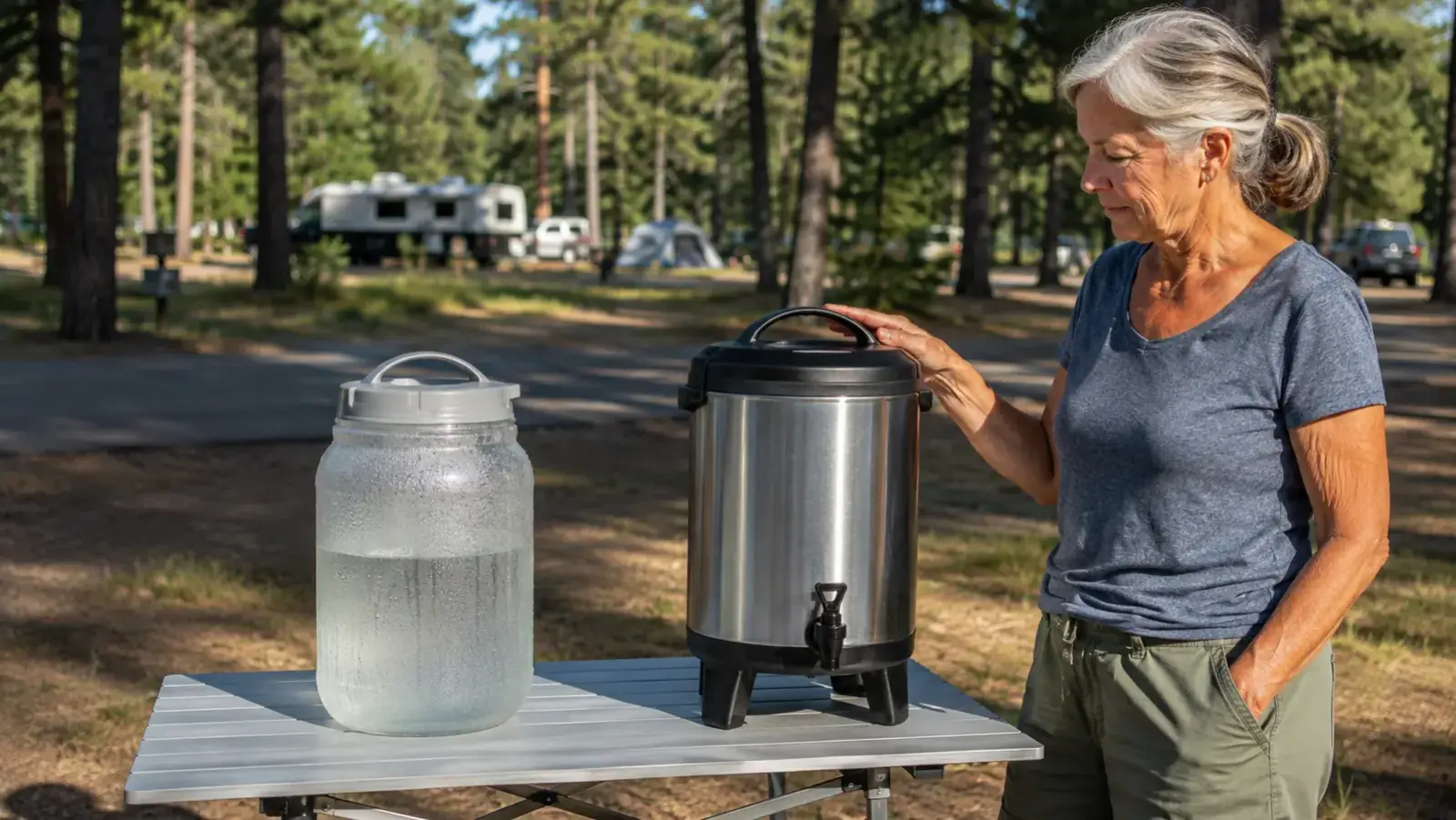
Who Should Buy Which
If you're camping with a dog, filling a bowl more than once a day, or you're setting up camp alone and want one less thing to wrestle with both hands, get the insulated dispenser. The extra weight and the extra cost buy you a spout that works with one hand and water that's still cold at dinner instead of just cool. I've had mine through four state parks and two more Corps campgrounds now and it hasn't let me down once.
If you're camping without a pet, you're only pouring water into a coffee pot or a cup once or twice a day, or you genuinely don't have the storage room for one more bulky item, the plain jug will serve you fine. There's no shame in it. It's why I still keep mine in the truck as backup for the days I need more total water than the dispenser holds.
Think in terms of a full camping season rather than one trip. Picture your worst afternoon, not your average one: the hottest day, the site with the least shade, a dog to keep watered through all of it. If that sounds like your camping, the dispenser earns its keep fast, because it's the thing I reach for every single day at a site, not just the hot ones. If your trips run shorter, cooler, or closer to a reliable water source, the jug may serve you just as well. I've written up how the dispenser has actually held up over months of daily use in my long-term review, and the full pros-and-cons breakdown, including the one thing I'd change about it, is in my honest review.
One less thing to wrestle with both hands at camp.
Same dispenser I fill at the table every morning, spout, folding stand, and insulation included.
Amazon Check Today's Price on Amazon →