
If you've read the reviews on this percolator's Amazon page before buying one, you already know what they say. Four and a half stars, tens of thousands of them, a long chorus of campers swearing this pot changed their mornings for the better. I bought this Farberware Classic Yosemite stainless percolator because of those reviews. A full year of near-daily use in my 24-foot trailer, hauling it between state parks and Corps of Engineers campgrounds with Biscuit riding along, has taught me those reviews left out more than they told me. Nobody was lying. They just weren't telling you about the burned knuckle, the four ruined pots before I got one right, or the fact that this thing simply will not make you one cup of coffee no matter how badly you want it to.
This is the review I wish someone had written for me before I spent thirty three dollars and a week of bad mornings finding all of this out the hard way. I still use this percolator. I am not talking myself out of it by the end of this piece. But a year is long enough to have opinions the box never warned me about, and I'd rather hand you those than another list of reasons to feel good about a purchase you haven't made yet.
The Quick Verdict
A solid, honestly built percolator that makes genuinely good coffee once you learn it, but it asks more patience and attention than the glowing reviews let on.
Amazon Check Today's Price →Before you buy this pot for the reviews, read what a full year of mornings actually looks like.
This is the same Farberware Classic Yosemite 8-cup percolator I've used at nearly every site for a year, stainless steel, no substitutions.
Amazon Check Today's Price on Amazon →How I've Used It
I've had this percolator a full year now, not the six months I hear most reviewers stretch a product to before writing about it. It rides in the outside kitchen bin of the trailer year round and has made coffee at a Corps of Engineers campground on Kentucky Lake more mornings than anywhere else, plus four state parks and two more Corps campgrounds scattered through the seasons. I brew on a two-burner propane camp stove most of the time, and directly over coals on the fire grate when I've got a fire going anyway, since that's the one thing you have to actually own a percolator for a full year to compare fairly.
What I want to do here is different from most reviews, mine included from earlier this year. I already wrote up the long-term wear report, the scorch marks, the basket after a hundred and fifty brews, and I'm not repeating any of that. This piece is the other half. The stuff that has nothing to do with how the metal holds up and everything to do with whether this pot is actually the right pick for you, told straight, with the parts that annoyed me left in instead of smoothed over.
A year gives you enough repetition to notice patterns the first few weeks can't show you. Which mornings go wrong and why. Which habits I built around this pot without realizing I was building them. And which of my early assumptions, formed in week one when everything still felt new and exciting, turned out to be wrong once the novelty wore off.
What the Five-Star Reviews Don't Tell You About the Taste
Percolator coffee does not taste like drip coffee, and it does not taste like a pod machine, and I wish someone had told me that plainly before I made the switch. It's stronger. It's rounder, if that makes sense, a fuller mouthfeel than the thinner cup you get from a drip filter. It also tastes a little old-fashioned, in the way your grandfather's coffee probably tasted if he made it on a stove. I like it now. I did not like it the first two weeks, and I nearly gave up and hauled my old machine back out of storage.
Here's what nobody selling you this pot wants to say out loud. Some people simply will not like percolator coffee, no matter how well they brew it. If what you actually want is a cup that tastes like the coffee shop drip you're used to, this pot is not going to get you there, and no amount of practice fixes that, because the brewing method itself produces a different result. I've made coffee for guests at my site who took one sip and asked, politely, if I had any instant instead. That's not a flaw in the pot. It's a mismatch between what percolators make and what some people's taste buds want, and it's worth knowing that about yourself before you spend the money.
I've come around to actually preferring it most mornings now, especially the ones where the air is cold enough that I want something that tastes like it's doing some work for me. But I'd be lying if I told you every reviewer giving this five stars loves the taste for the same reason I eventually did. Plenty of them are used to strong stovetop coffee already and this pot just met an expectation that was already there. If yours isn't, go in with your eyes open.
The Handle and the Window Knob Will Catch You Off Guard
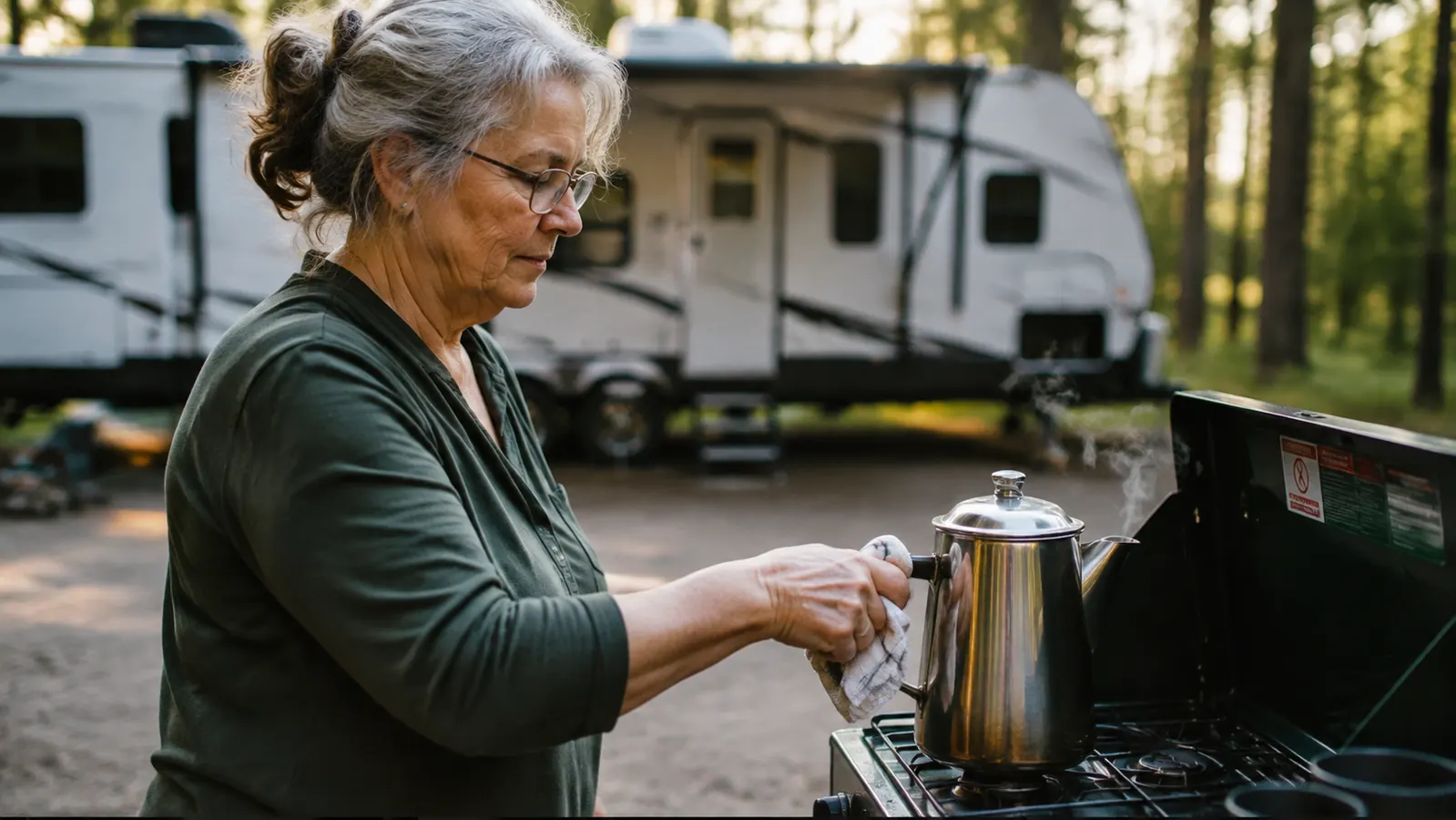
The handle on this percolator gets hot. Not warm, hot. I learned this the first week when I grabbed it bare handed the way I'd grab a drip carafe, and I don't do that anymore. I keep a folded dish towel or a silicone glove sitting right next to the stove now, every single morning, because the handle heats up fast over an open flame and stays hot long after the coffee's done perking. This isn't a defect. It's just a fact about a metal handle on a metal pot sitting directly over fire, and it's the kind of thing a listing photo never shows you.
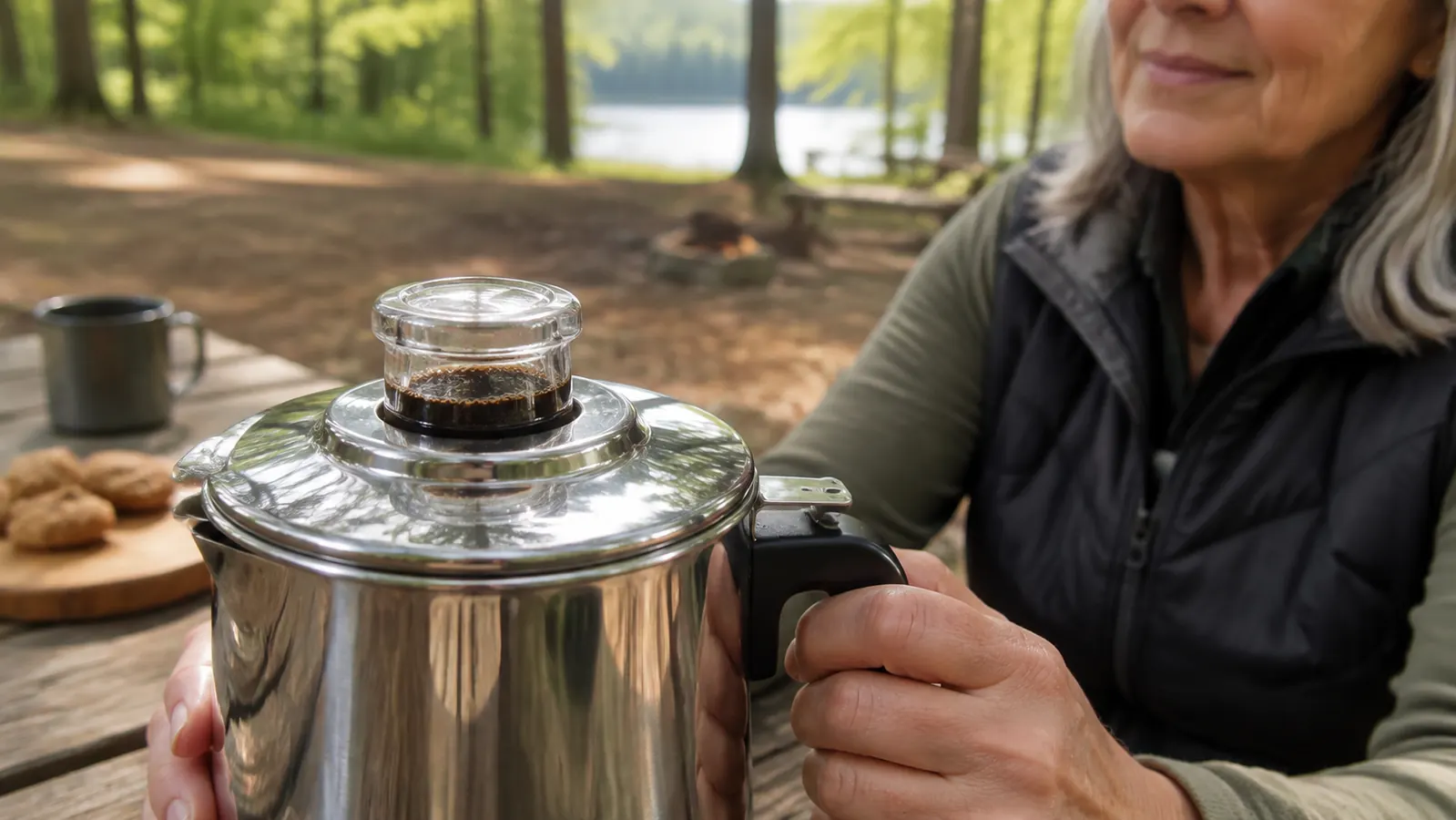
The little glass knob on top of the lid is how you're supposed to judge whether the coffee is ready, watching the color of the perking liquid darken through that small window. It sounds simple and it mostly is, but it means this pot wants your attention while it works. Walk away to hook up the water line or wrangle Biscuit away from another campsite's trash, and you will come back to something bitter. I've done this more times in a year than I want to admit, standing there stirring cranky over-perked coffee because I trusted the pot to babysit itself the way a drip machine does.
The window knob also gets hot enough to sting if you touch it to check progress, which I still catch myself doing out of habit from years of drip machines with a simple light that tells you when it's done. There's no light here. There's a small glass eye you have to actually watch, and that means percolator coffee asks something of you that most modern coffee makers don't, which is a few minutes of standing there paying attention instead of walking off to do three other things.
Don't Buy This If You Only Want One Cup
This is the one nobody warns you about clearly enough, and it should be higher up in every listing than it is. This percolator does not do a single cup well. It's built to make a pot, and it wants a real amount of water and grounds in it to work the way it's supposed to. Try to brew a small amount for just yourself on a morning when you don't want much, and you'll get something uneven, either weak because there wasn't enough coffee cycling through the stem, or scorched on the bottom because there wasn't enough water to protect the metal from the direct flame.
I found this out on a morning I only wanted half a cup before an early drive to a state park two hours off. I scaled everything down and ended up pouring most of it out, bitter on top and thin underneath, nothing like the coffee I'd gotten used to. Since then I've accepted that this pot is an all-or-nothing proposition. Either I'm making the full eight cups, or I'm reaching for the little travel kettle I keep for exactly those mornings.
If you camp alone the way I do most weeks, that means you're either drinking a lot of coffee, giving some away, or reheating leftovers the next morning, none of which is a dealbreaker, but all of which is worth knowing going in. A single-serve pod machine or a small pour-over setup will always beat this pot for the person who genuinely only wants one cup and doesn't want the rest sitting around.
Stainless Doesn't Mean Stain-Proof
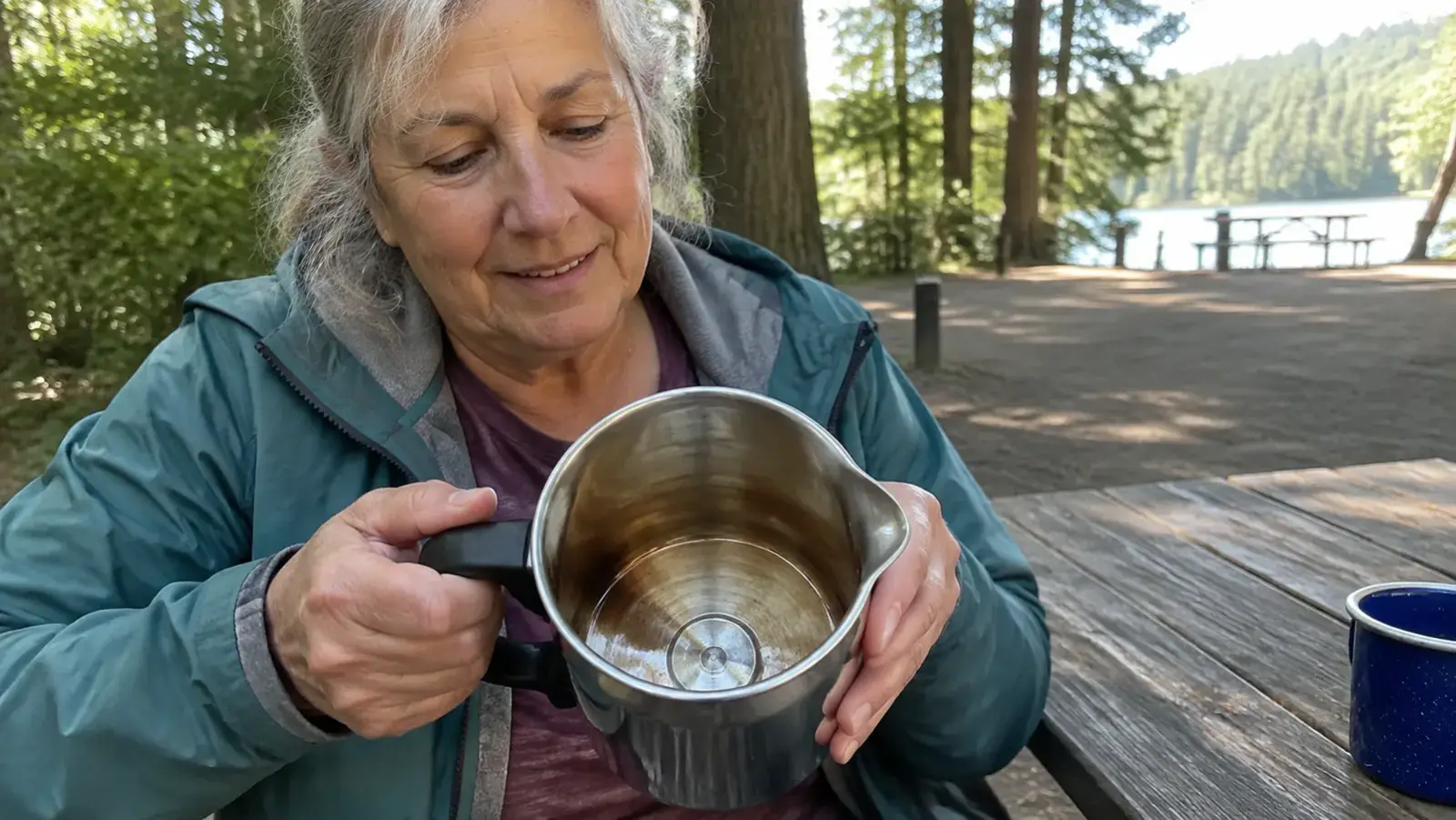
I assumed, wrongly, that stainless steel meant this pot would look the same inside a year from now as it did the day I unboxed it. It doesn't. The inside of the pot, not just the base where the flame hits, has picked up a faint brown tint over a year of coffee passing through it every morning. It's not rust, and it hasn't affected the taste or the safety of the pot as far as I can tell, but it's there, a coating that a good scrub with baking soda softens but doesn't fully erase.
I've read plenty of reviews that treat stainless steel like it's some kind of stain-proof material, and after a year I can tell you that's marketing language more than kitchen reality. Coffee is acidic and it sits inside this pot for the length of every brew and every bit of the pour. Over a year of daily use, that leaves a mark on the metal the same way a coffee mug you never quite get all the way white again does. It's cosmetic, not structural, but if you're the kind of person who wants gear that photographs like new for years, this isn't going to be that pot on the inside any more than the sibling review already told you it wouldn't be on the outside.
Most People Quit Before They Get Good at This, and Wind Makes It Worse
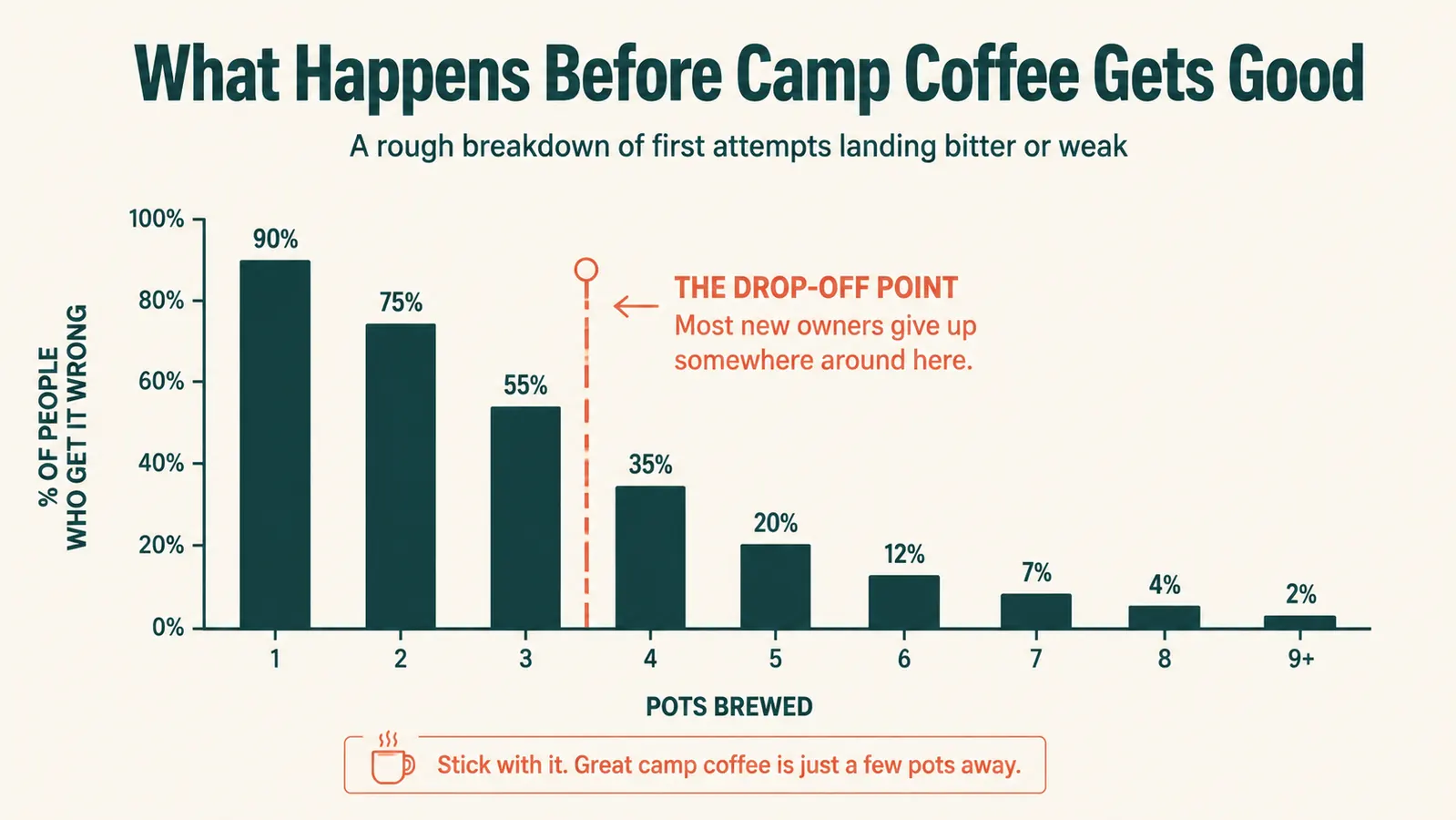
There's a learning curve to this pot that goes past just timing. It's a several-pots-of-bad-coffee curve, and I think most people who buy this percolator and never come back to leave a review are the ones who quit somewhere in the middle of it. I've talked to two different neighbors at two different campgrounds this year who bought the same pot after seeing it on my picnic table, and both of them told me, almost word for word, that they gave up after their third pot came out either bitter or weak and went back to instant. I don't blame them. Instant is forgiving. This pot is not, not at first.
What made it worse for both of them, and for me on a few mornings, is wind. This percolator wants a fairly steady heat the whole way through the brew. A gust that keeps guttering your camp stove's flame, the kind you get at an exposed site near open water or up on a ridge, means the pot never settles into a rhythm. It perks hard for a minute, dies down when the flame dips, then surges again when the wind lets up, and the coffee that comes out of an uneven brew like that is worse than either extreme on its own. I've had to build a little windbreak out of my cooler and a folding chair more mornings than I expected, just to keep the flame honest long enough for the pot to do its job.
If you camp somewhere with reliably calm mornings, this is a smaller problem than it sounds. If your usual sites are open, breezy, or near a lake the way mine at Kentucky Lake often are, plan on the wind fighting you some mornings no matter how good you've gotten at everything else. That combination, a real learning curve plus a pot that punishes an unsteady flame, is exactly why I think this percolator has a higher quiet return rate than its star rating would suggest. The people who stuck it out are the ones leaving the five-star reviews. The people who didn't mostly just went silent and switched back to something easier.
What I Liked
- Makes genuinely good, strong coffee once you've learned its particular timing
- Sturdy stainless build that has taken a year of hard travel and hot flame without failing
- Wide mouth basket is manageable to clean by hand in a camp basin
- 8-cup size is generous if you're happy making a full pot most mornings
- Handle and lid knob have stayed solid through a year of daily heat
Where It Falls Short
- Percolator taste is genuinely different from drip and some people won't like it, period
- Handle gets hot enough that you need a towel or glove every single time
- The window knob demands attention, walk away and you'll over-perk it bitter
- Poor at making a single small cup, it really wants a full pot
- Inside of the pot discolors with coffee tannin over time, not just the flame-side base
- Real learning curve of several bad pots before it's consistently good
- Wants steady heat, a windy site fights the flame and ruins the brew
The five-star reviews are real. So is the drawer of ruined coffee grounds it took me a year to stop producing.
Who This Is For
This percolator is for someone who camps often enough to get past the learning curve and drinks enough coffee that a full 8-cup pot most mornings makes sense, whether that's you alone with leftovers the next day or you plus a guest at the site. It's for someone who doesn't mind a little attention while their coffee brews, who's willing to keep a towel by the stove, and who camps somewhere with reasonably sheltered mornings, or is willing to build a windbreak on the rough ones. If any of that sounds like the trailer life I lead most of the year, this pot earns its keep. I've written more about the mornings it's been part of in my campfire coffee story, and if you want the exact steps I finally landed on after a year of trial and error, I laid those out plainly in how to make camp coffee with a percolator.
Who Should Skip It
Skip this one if you only want a single cup most mornings, if you camp rarely enough that you'll be relearning the timing from scratch each trip, or if you know for a fact you prefer the taste of drip coffee and aren't looking to change that. Skip it too if your usual sites are windy and you're not willing to fuss with a windbreak, or if you want gear that stays looking pristine inside and out, since staining is part of the deal here whether the flame touches it or not. A pod machine, a simple pour-over, or a French press will serve any of those campers better than this pot ever will.
A year in, warts and all, this is still the pot I reach for.
Same 8-cup Farberware Classic Yosemite percolator, stainless steel, the exact one I've used at nearly every site for a full year.
Amazon Check Today's Price on Amazon →