
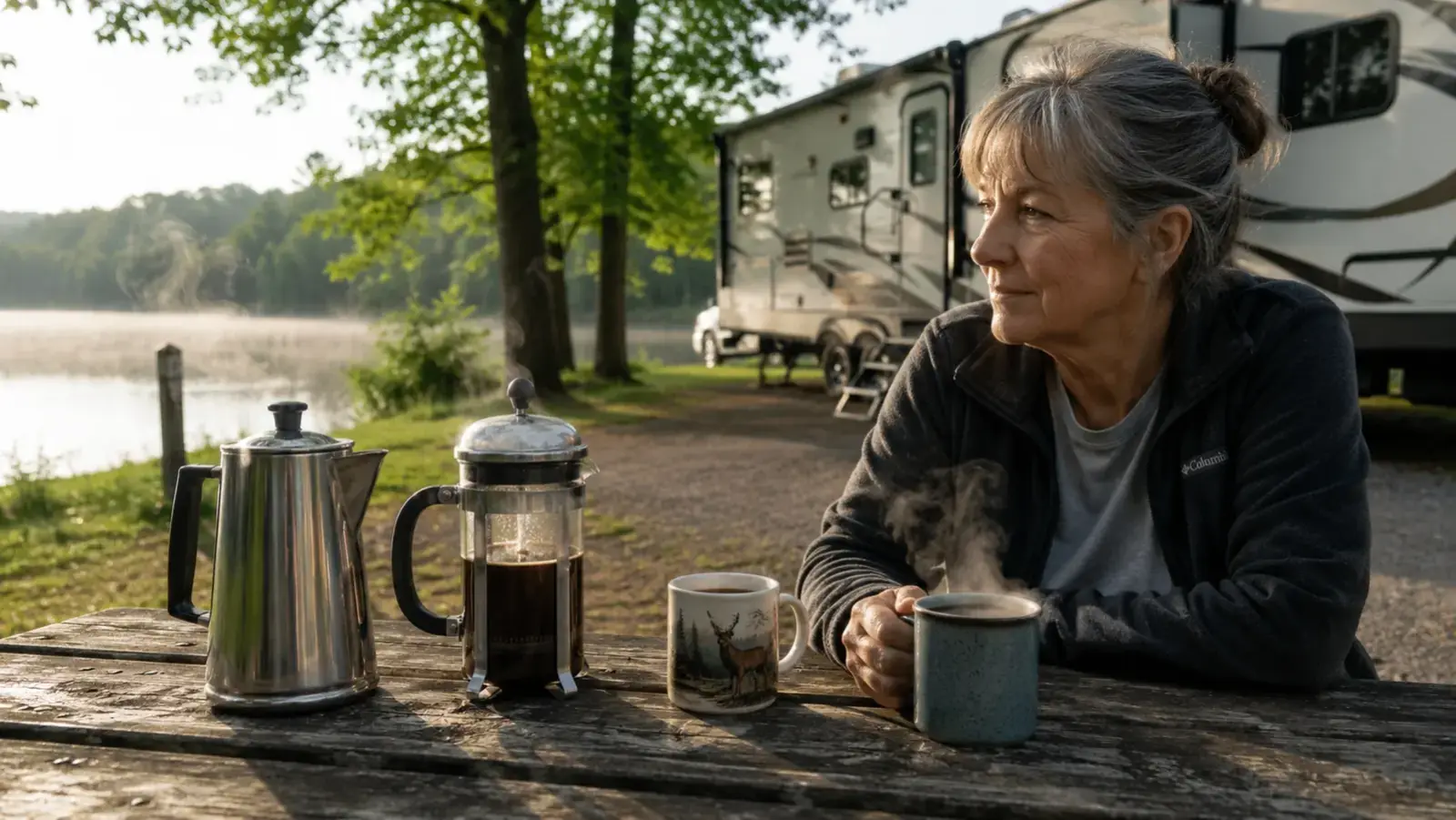
If you only want the short answer, here it is. For someone making coffee alone at a campsite most mornings of the year, over a camp stove or an actual fire, the stainless percolator wins. It's not close on durability, and it's not close on how little you have to think about it once it's on the heat. But I'm not going to pretend the French press has nothing going for it, because it does, and I'd be lying to you if I said otherwise.
I've made coffee both ways for years of camping, first with a glass camp French press I babied for two seasons before it cracked, and for the last several months with the Farberware Classic Yosemite percolator I now trust enough to leave sitting on the stove while I go feed Biscuit and check on the cats in the trailer. Here's how the two actually stack up, row by row, no thumb on the scale.
I ran this comparison the plain way, no lab notes, just real mornings. Same beans from the same bag, same coarse grind, same water straight from my jug, alternating between the two for two weeks straight before I let myself settle on an answer. That felt like the only fair way to decide something I was going to live with every single day, not just the first weekend.
| Farberware Yosemite Percolator | Camping French Press | |
|---|---|---|
| Durability over an open flame | Stainless steel body sits directly on coals or a stove burner without a second thought | Glass carafe cannot go near open flame at all, and even radiant heat close to a fire risks a crack |
| Breakage risk in a moving rig | Metal, nested in a cabinet, survives washboard roads and gravel campground entrances without complaint | Glass carafe has to be wrapped and cushioned every single time you pack up, or it doesn't ride at all |
| Frees up your stove once water's hot | Has to sit on the heat source for the entire perking cycle, roughly eight to ten minutes | Only needs water boiled once, then you can pull it off the burner and use the stove for eggs while it steeps |
| Forgiving if you walk away | Can over-perk and turn bitter or scorched if you forget it on high heat for too long | Steep time is more forgiving, and a few extra minutes off the heat rarely ruins the pot |
| Brew capacity for a group | Eight cups in one batch, enough for two people and a thermos with some left over | Most camping French presses top out around four cups, so a group means a second batch |
| Cleanup without a sink hookup | Lift the basket out, tap the grounds into the fire ring or trash, rinse the metal parts with a splash from the water jug | Wet grounds have to be knocked loose from the bottom and the fine mesh screen scrubbed clean or the next pot tastes stale |
| Grit and sediment in the cup | A little fine grit always settles in the bottom of the mug by the last sip, no matter how careful the grind | A good grind through the mesh filter leaves a noticeably cleaner cup with less sediment |
| Long-term value over years | All stainless construction, nothing to replace, still working like new after a full season of daily use | Glass carafe and mesh screen wear out or crack eventually and have to be replaced separately |
Where the Percolator Wins
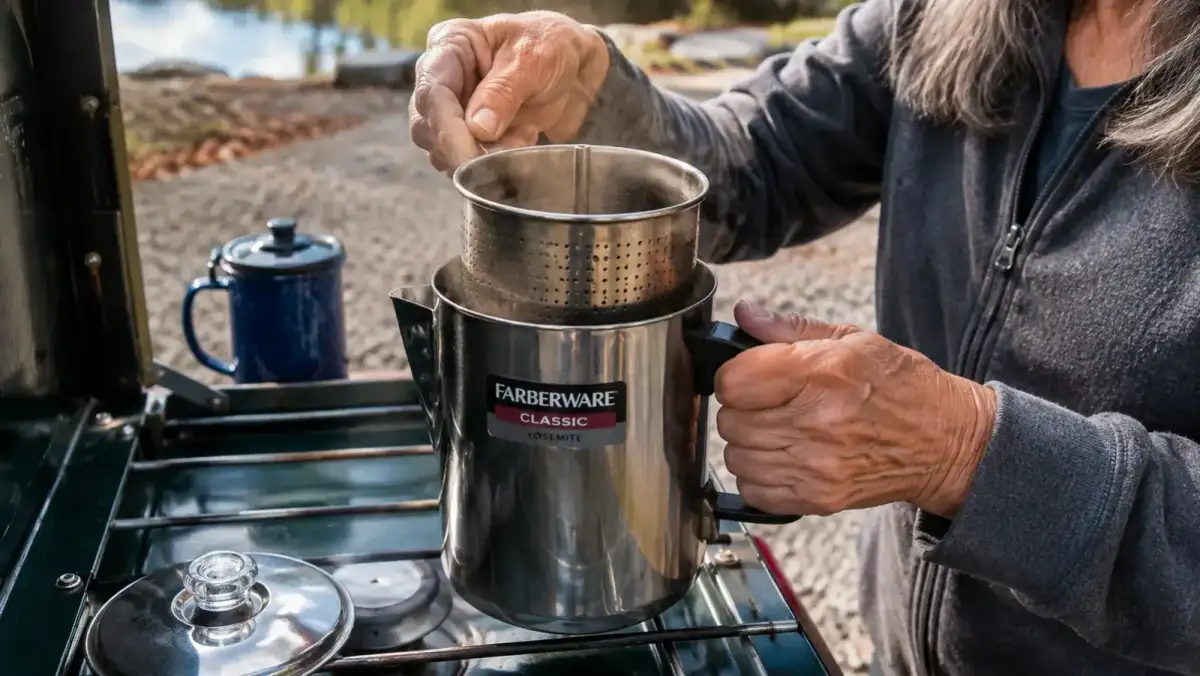
The thing that sold me on the Farberware percolator wasn't the coffee itself, at least not at first. It was that I could set it on the camp stove, walk off to let Biscuit out and check that Pearl and Sable hadn't gotten into anything in the trailer, and come back to a full pot instead of a puddle of broken glass. That matters more when you're doing every single part of setting up and breaking camp by yourself. Nobody's watching your gear for you, and nothing about your morning routine should require both hands and your full attention the entire time.
It also just holds up better to the reality of how gear actually travels. Mine has been dropped once on a gravel pad at a state park, bounced around a cabinet through some rough Corps of Engineers access roads, and left sitting near coals more times than I can count. A percolator basket lifts straight out for dumping grounds, which means cleanup doesn't need running water, just a splash from my drinking jug and a paper towel. For eight cups in one go, which covers me and usually a neighbor who wanders over smelling real coffee instead of instant, nothing about the French press competes on capacity.
And there's a durability argument here that isn't really about the coffee at all. Anything glass at a campsite is one bad moment away from becoming a hazard, not just a loss. I don't want to be picking shards out of gravel at seven in the morning with my knees the way they are. Stainless steel doesn't ask me to worry about that.
There's also nothing extra to lose. The percolator is one piece, basket and stem included, and that's the whole kit. A French press eventually needs a replacement filter screen or a new plunger seal, and those aren't the kind of parts you find at a bait shop next to a Corps of Engineers boat ramp. When something in your camp kitchen breaks two states from home, simple wins.
A percolator only needs a stove and something to point it at. That's most of the reason it survives roads that shake apart everything else in the cabinets.
Where the French Press Wins
I want to be fair here, because the French press earned its two seasons with me honestly. Once the water's boiled, you're done needing the stove. That's a real advantage if you're cooking breakfast on a single burner and don't want a pot hogging the only heat source for ten minutes while eggs wait. I used to boil water, pour it over the grounds, set a timer, and go start breakfast while it steeped. The percolator can't do that. It needs the heat the whole time.
The French press is also more forgiving if your attention wanders, which mine does more than it used to. Percolators can scorch if you leave them perking too long on a hot fire, and a scorched pot of coffee is a wasted pot of coffee. A French press left steeping five extra minutes is rarely ruined, just a little stronger. And the cup itself is genuinely cleaner. A good grind through that mesh filter leaves less grit at the bottom of the mug than a percolator ever will. If you're someone who notices sediment and it bothers you, that's a legitimate reason to lean French press.
I'll also say this. On a still morning with nobody around, there's something nice about not hearing a pot rattle and burble on the stove the way a percolator does. The French press is quiet, and if you're someone who likes that first cup in near silence before the rest of the world wakes up, that's worth something too.
If you're the one making coffee alone most mornings, here's the pot that won't let you down.
The Farberware Yosemite percolator is stainless steel through and through, handles a full eight cups, and has survived every rough road and gravel pad I've put it through this year.
Amazon Check Today's Price on Amazon →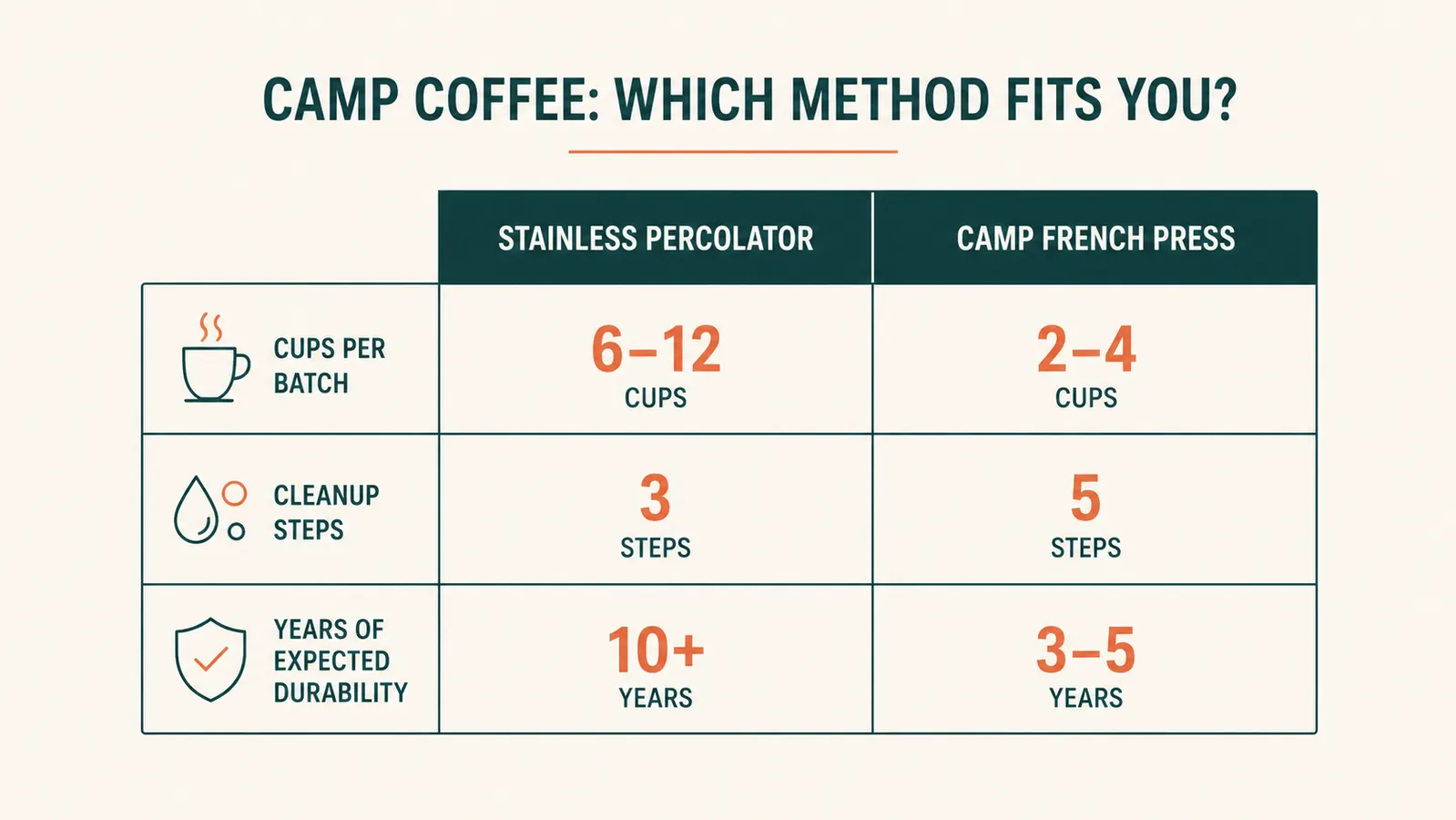
What Six Months of Trailer Coffee Actually Taught Me
The French press I retired didn't fail because it made bad coffee. It failed because it was glass, and glass and a moving trailer eventually find each other. Mine cracked during a transfer from the cabinet to the counter, not even from an accident, just from ordinary handling after two seasons of small stresses adding up. I didn't replace it with another French press. I bought the percolator instead, mostly because I was tired of wrapping a carafe in a dish towel every single time I packed up camp.
What I didn't expect was how much less I'd think about the whole process. With the percolator, I fill the basket, add water to the fill line, set it on the stove or right at the edge of the coals if I've got a fire going, and go do something else. I've made it at a Corps of Engineers site on Kentucky Lake in April with nobody else around for a mile, and I've made it at a crowded state park in July with three other campsites within earshot. It behaves the same way both times, which is more than I can say for how my knees feel some mornings.
The Morning Routine Itself
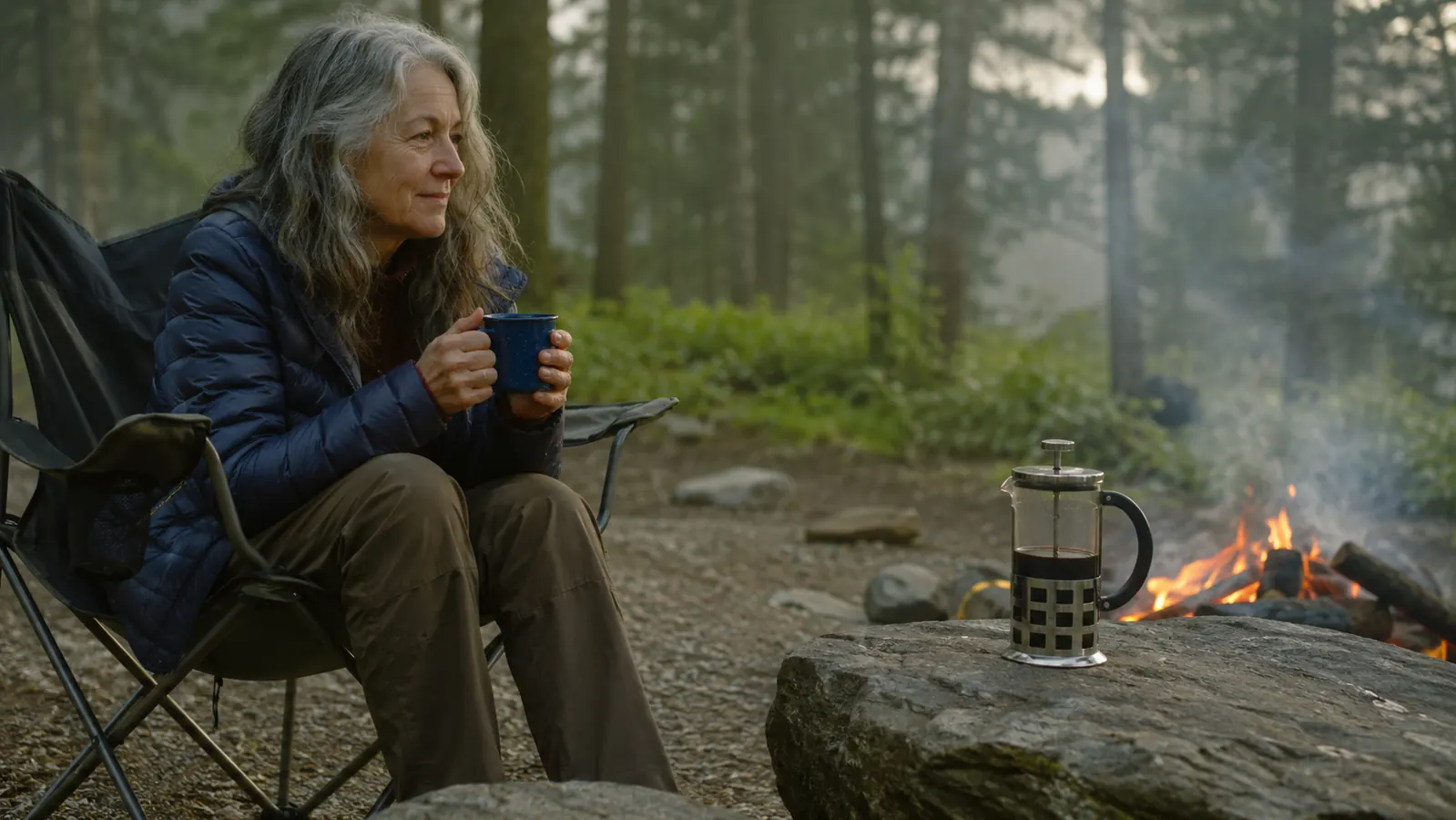
Here's what the two mornings actually look like, side by side. With the percolator, I fill the basket, set it on the burner, and go do chores, letting Biscuit out, checking the propane level, folding up the awning if I'm breaking camp that day. Ten minutes later it's done, and I never touched it again after lighting the stove.
With the French press, I'd boil water first, which meant standing at the stove anyway since I never trusted myself to walk off with an open flame going. Then I'd pour, stir, set a timer, and still hover close enough to hear the wind if it picked up and knocked the press over. Four minutes isn't long, but four minutes of standing around adds up over a whole season of mornings when I'd rather be doing chores or just sitting still with my coffee.
I still think the French press has a place for some campers, especially anyone with two hands free and a partner to watch the stove while the other one manages breakfast. That's just not my morning most days. I set up alone, I break camp alone, and the coffee pot has to be one less thing I'm minding while I do it. If you want the fuller story on how this exact percolator has held up over a whole season of daily use, I wrote all of that up in my long-term review, and if you want the plain, cons-included version with nothing softened, that's in my honest review.
Who Should Buy Which
If you camp with a partner, cook on a single burner, and one of you can dedicate attention to a French press while the other handles the stove, it's a legitimate choice and you'll get a cleaner cup for it. But if you're setting up camp by yourself, cooking breakfast on the same stove you're brewing on, and you want a pot that survives the rough roads to get to a Corps of Engineers site in the first place, the percolator is the one I'd hand you. It's stainless, it forgives being left alone for a few minutes longer than planned, and it makes enough for two people without a second batch. That's the whole reason it's the one still riding in my trailer.
Price plays into this too, though I won't quote you numbers since they shift. What I'll say is that neither of these costs much next to a lot of camp gear, and neither one is precious enough to keep you awake at night wondering if it survived the drive down a rough access road. The difference is what happens after a full season of using it, not what happens the first week you bring it home.
Give your mornings the coffee pot that doesn't need babysitting.
Same percolator I've used at every campsite this year, stainless steel from top to bottom, eight cups in one batch.
Amazon Check Today's Price on Amazon →